

Table of Contents
The UAE’s electronic invoicing framework is no longer a future consideration—it is now an immediate operational requirement.
With the release of Version 1.1 of the UAE Electronic Invoicing Guidelines on June 1, 2026, the Ministry of Finance has officially moved the conversation from planning to execution. Businesses across the UAE must now ensure their systems, processes, and tax governance frameworks are fully aligned with the latest compliance requirements.
According to the UAE Ministry of Finance, e-invoicing will become a major component of digital tax governance in the country. Businesses that continue relying on manual processes or outdated ERP workflows risk significant compliance exposure during future audits.
Working with experienced UAE tax compliance specialists can help organizations prepare for these regulatory changes effectively.
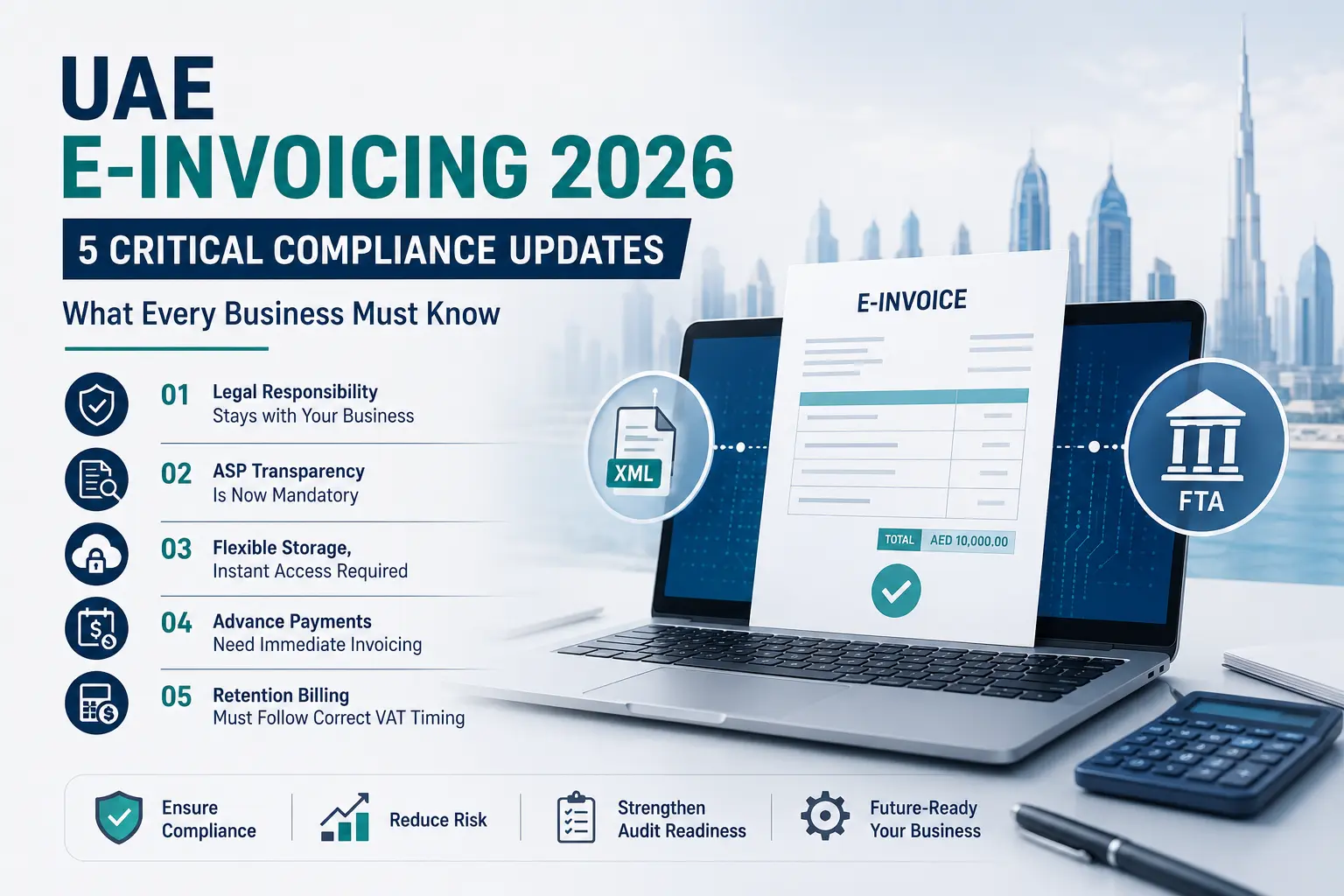
In this guide, we cover the five most critical UAE E-Invoicing realities every business should address immediately.
1. Legal Responsibility Remains with Your Business
Many companies assume that using an Accredited Service Provider (ASP) transfers compliance responsibility. This is incorrect.
Even if invoice storage, transmission, or processing is outsourced, legal accountability remains entirely with the taxpayer. Your business must ensure:
- Full access to invoice records
- Proper electronic data retention
- Audit-ready documentation
- Historical record accessibility
Businesses should carefully review ASP contracts to ensure audit rights, data portability, and historical record access remain protected.
Why This Matters
During an audit, your company—not your software provider—will be held responsible for missing records or compliance failures.
2. ASP Transparency Is Now Mandatory
Under the updated framework, ASPs are expected to maintain far more than basic invoice routing. They must preserve:
- Technical logs
- Transaction identifiers
- Routing metadata
- Delivery confirmations
These records form the foundation of audit defense.
A critical requirement is confirmation without undue delay, meaning your provider must prove invoices were successfully transmitted to the relevant authority.
Working with experienced tax advisory experts can help businesses evaluate ASP agreements and reduce compliance risks.
Why This Matters
If transaction logs are incomplete, proving compliance during an audit becomes extremely difficult.
3. Flexible Storage Is Allowed — But Instant Access Is Required
The UAE allows businesses to store e-invoicing data across different systems and geographic locations. This benefits companies using:
- Cloud ERP systems
- Global accounting platforms
- Multinational infrastructure
However, storage flexibility does not reduce compliance obligations.
Your UAE team must still retrieve invoice records immediately during an audit.
According to the Federal Tax Authority (FTA), businesses must maintain accessible and reliable tax records for regulatory review.
Key Risk
Many businesses assume cloud storage automatically guarantees compliance. It does not. Accessibility and retrieval speed are equally important.
4. Advance Payments Need Immediate Invoice Generation
Advance payments remain one of the most overlooked compliance areas.
The updated guidelines confirm that receiving an advance payment triggers an immediate tax invoice requirement.
Your accounting system must:
- Generate an advance invoice immediately
- Link the final invoice using technical references
- Maintain a complete audit trail
Legacy ERP systems often struggle with this workflow and may require customization.
Common Mistake
Manual invoice references create broken audit trails and increase compliance risk.
5. Retention Billing Must Follow Correct VAT Timing
Retention billing often creates confusion in VAT reporting.
The Ministry’s guidance allows businesses to issue invoices only for amounts currently payable, excluding retained amounts until they become due. This helps businesses:
- Avoid premature VAT recognition
- Improve invoice accuracy
- Maintain compliant billing cycles
However, both invoices must remain fully aligned with VAT and e-invoicing regulations.
Why This Matters
Improper retention billing can trigger unnecessary VAT liabilities and increase audit scrutiny.
How to Prepare for UAE E-Invoicing Compliance in 2026
To remain compliant, businesses should prioritize the following:
Review Your ERP System
Ensure your software supports invoice automation, reference mapping, and audit-ready reporting.
Audit Your ASP Contract
Confirm data portability, access rights, and compliance obligations.
Strengthen Data Governance
Create retention and retrieval procedures for all tax documents.
Train Internal Teams
Finance, accounting, and operations teams must understand workflow changes.
The UAE’s e-invoicing model increasingly aligns with international digital tax standards, making early preparation even more important.
How Imperium Accounting & Tax Consultants Can Help
At Imperium Accounting & Tax Consultants LLC, we help businesses move from theoretical readiness to practical compliance. Our services include:
- ERP workflow optimization
- ASP compliance reviews
- VAT and e-invoicing alignment
- Audit readiness assessments
- Compliance gap analysis
We help businesses build systems that can withstand the UAE’s increasingly digital tax environment.
Imperium Accounting & Tax Consultants LLC supports businesses in preparing for UAE e-invoicing audits with practical, compliance-focused solutions.
Final Thoughts
The real question is no longer whether UAE E-Invoicing 2026 will affect your business—it is whether your systems are prepared for it.
Hidden compliance gaps often surface during audits, when remediation becomes expensive and disruptive.
The right preparation today can prevent major liabilities tomorrow.
If your business needs help assessing readiness, strengthening workflows, or reviewing ASP compliance, Imperium Accounting & Tax Consultants LLC is ready to support your transition into the UAE’s 2026 e-invoicing environment.