
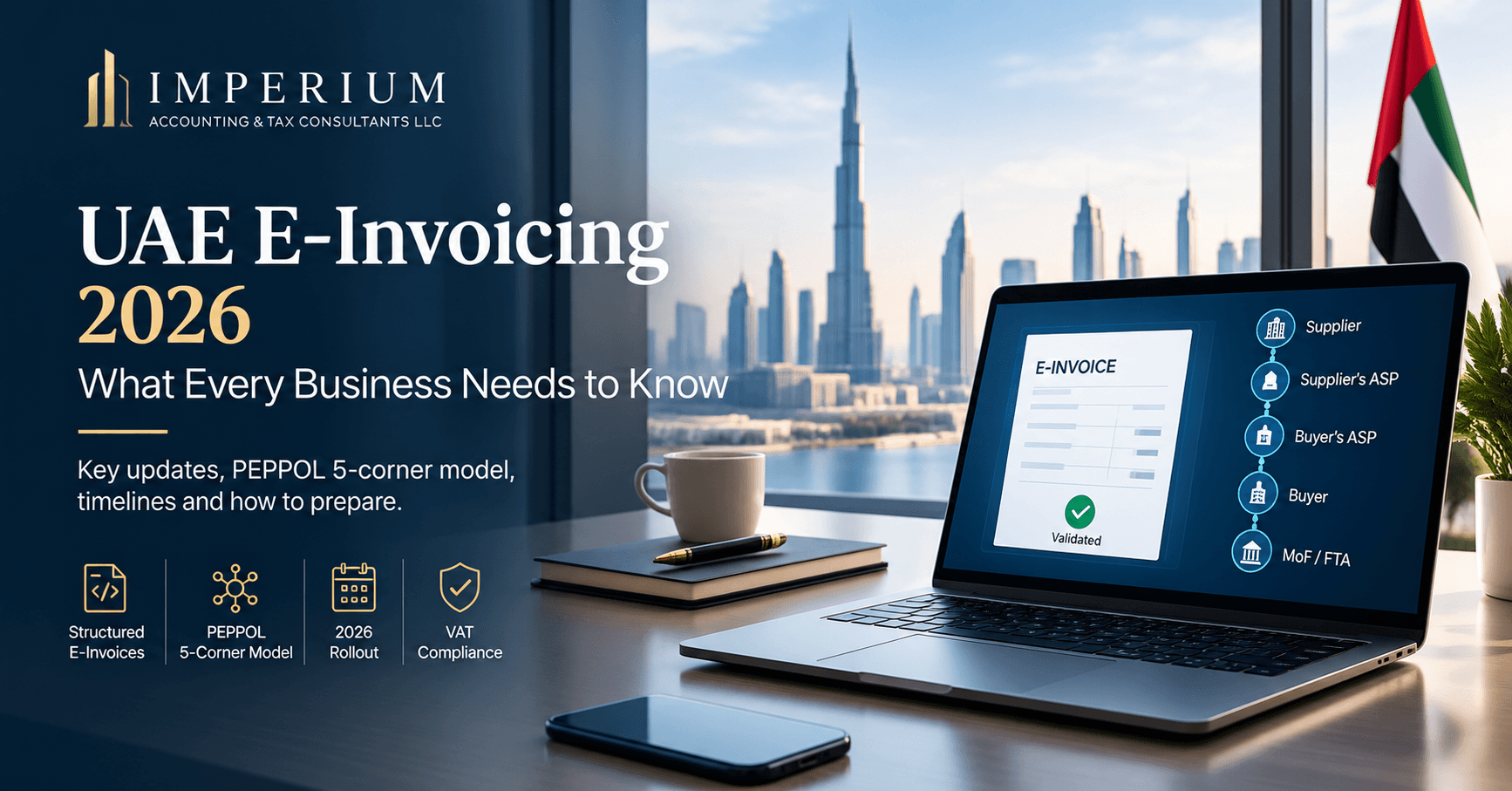
The UAE is entering a new era of tax digitalisation, and the change is far more significant than simply replacing PDFs with electronic files. Beginning in 2026, the UAE E‑Billing System will transform how businesses issue invoices, report VAT, and manage financial workflows. Traditional PDF invoices, scanned bills, and manual data entry will no longer be enough. The future is structured, machine‑readable e‑invoicing.
At Imperium Accounting & Tax Consultants, we believe this transition is one of the most important compliance milestones since VAT was introduced in 2018. Understanding what’s coming and preparing early will be critical for every UAE business.
Why E‑Invoicing Matters
A PDF invoice is essentially a digital photo. Humans can read it, but systems cannot process it without manual effort. E‑invoicing changes this by requiring invoices to be issued in structured XML format, allowing automated validation, instant transmission, and seamless integration between different ERPs.
This shift brings major advantages:
- Automated VAT compliance with fewer errors
- Lower operational costs through reduced manual work
- Faster payment cycles due to instant delivery
- Greater transparency and reduced tax leakage
- Global compatibility with international digital standards
Inside the 5‑Corner PEPPOL Model
The UAE has adopted the PEPPOL “5‑corner” decentralized model — a secure digital network where Accredited Service Providers (ASPs) act as regulated intermediaries.
- Supplier (Corner 1): Issues the invoice through their ERP.
- Supplier’s ASP (Corner 2): Validates the invoice and transmits it securely.
- Buyer’s ASP (Corner 3): Receives and forwards the validated invoice.
- Buyer (Corner 4): ERP is automatically populated with accurate invoice data.
- MoF/FTA (Corner 5): Receives real‑time extracts from ASPs for VAT oversight.
For VAT groups, each entity must maintain its own ASP endpoint, even though the group shares a single TRN.
Who Is in Scope?
The mandate applies to all VAT‑registered taxpayers issuing tax invoices. The rollout will begin with large businesses and gradually expand to SMEs.
In-scope transactions include:
- Domestic B2B and B2G transactions
- Exports, using international PEPPOL addresses where available
B2C transactions will follow in later phases.
Legislation & Timeline
Recent amendments — Federal Decree-Law No. 16 and 17 of 2024 — formally define electronic invoices and empower the MoF to set requirements and deadlines.
Key milestones:
- Late 2024: Legal groundwork completed
- Mid‑2025: ASP accreditation and detailed rules
- Q2 2026 onwards: Phase 1 go‑live
Lessons from Saudi Arabia
KSA’s successful rollout offers valuable guidance:
- Start system upgrades early
- Assess ERP and ASP integration needs
- Train cross‑functional teams
- Engage with accredited providers as soon as they are announced
Final Thoughts
E‑invoicing is not just a compliance requirement — it is a strategic upgrade. Businesses that prepare early will benefit from smoother operations, faster payments, and stronger VAT governance.
Imperium Editorial Team
Accounting & Tax Insights
Research and analysis from the Imperium Accounting & Tax Consultants LLC team, reviewed for accuracy before publication.