

Table of Contents
Financial reporting is entering one of its biggest transformation periods in decades. The 2026 IFRS updates introduce significant changes that affect how businesses classify financial assets, present financial statements, report ESG-linked transactions, and comply with evolving international accounting standards.
For CFOs, finance managers, and business owners across the UAE, staying ahead of these developments is essential. Rather than simply complying with new accounting standards, organizations should begin strengthening their financial reporting systems today to ensure a smooth transition.
At Imperium Accounting & Tax Consultants LLC, we help businesses prepare for changing financial reporting requirements with practical accounting, tax, and compliance solutions.
👉 Learn more about our professional accounting services:
https://imperiumatc.ae/
Why the 2026 IFRS Updates Matter
Although IFRS 18 officially becomes effective on 1 January 2027, comparative financial information must also comply with the new standard. This means businesses should have updated accounting systems, reporting structures, and internal policies ready from 1 January 2026.
Delaying implementation could result in reporting inconsistencies, increased audit challenges, and unnecessary compliance risks.
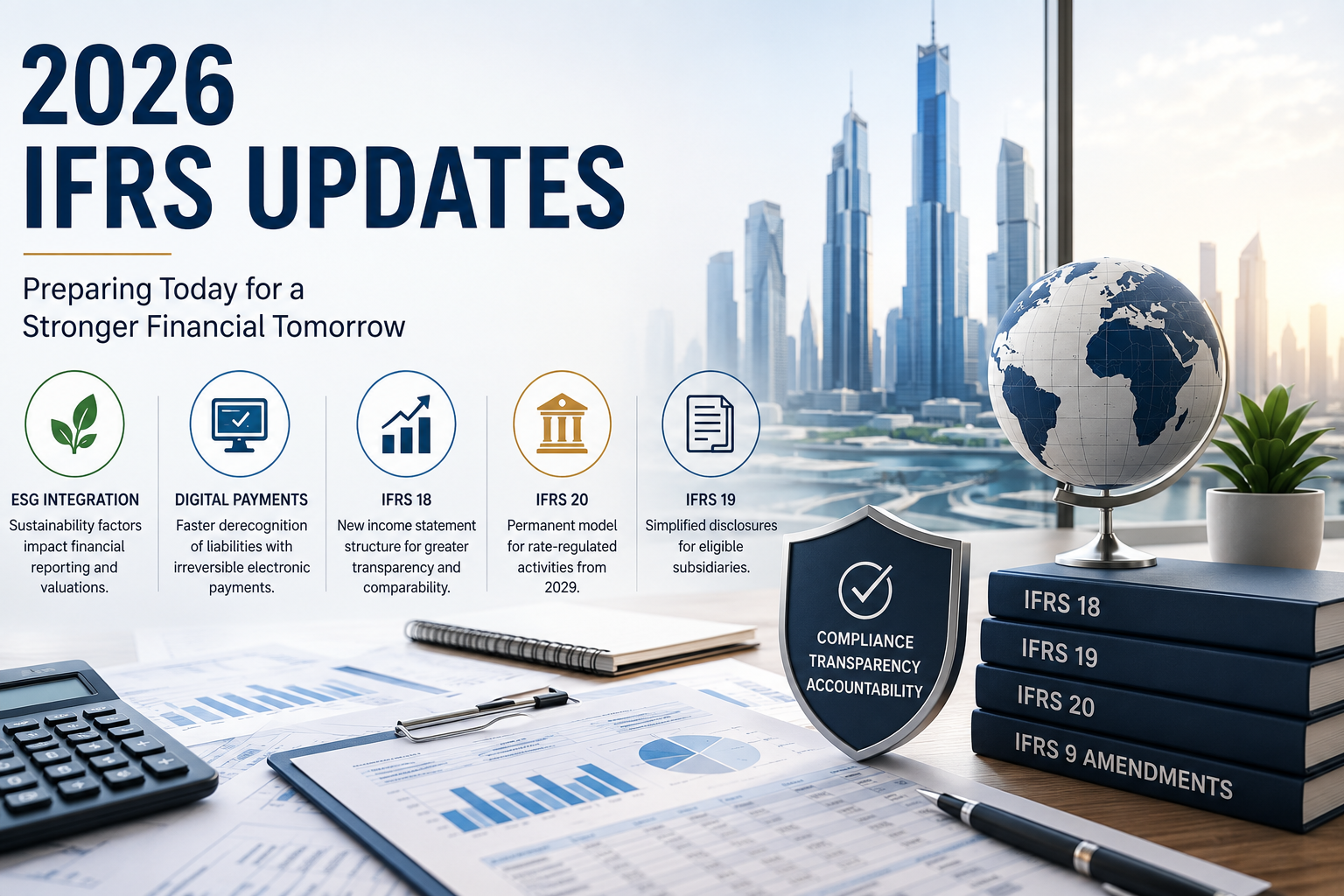
Below are the five major IFRS developments businesses should understand.
1. ESG-Linked Cash Flows Now Affect Financial Asset Classification
Recent amendments to IFRS 9 and IFRS 7 make sustainability-related contractual features an important part of the Solely Payments of Principal and Interest (SPPI) Test.
This means ESG-linked financial instruments—such as loans where interest rates change based on carbon emission targets—must now be evaluated when determining whether they should be measured at:
- Amortised Cost
- Fair Value Through Profit or Loss (FVTPL)
- Fair Value Through Other Comprehensive Income (FVOCI)
The amendments also provide additional guidance for Power Purchase Agreements (PPAs) involving nature-dependent electricity.
Where contracts satisfy the “Own Use” exemption, they may continue to be treated as executory contracts. Otherwise, derivative accounting applies, although new hedge accounting flexibility has also been introduced.
Key Takeaway
ESG considerations now directly influence financial asset classification—not just sustainability reporting.
2. Digital Payment Rules Allow Earlier Derecognition of Financial Liabilities
The updated IFRS 9 amendments also modernize accounting for electronic payment systems.
Companies may now derecognize financial liabilities earlier when:
- Payment has been initiated electronically
- The payment cannot be cancelled
- The payment cannot be reversed
This better reflects today’s banking environment and provides finance teams with a more accurate representation of outstanding liabilities at reporting dates.
Key Benefit
Treasury reporting becomes more accurate while reducing timing differences between accounting records and banking transactions.
3. IFRS 18 Introduces the Biggest Income Statement Changes in Years
One of the most significant 2026 IFRS updates is the introduction of IFRS 18, replacing IAS 1 Presentation of Financial Statements.
The new standard creates a standardized structure for the Statement of Profit or Loss by requiring all entities to classify income and expenses into:
- Operating activities
- Investing activities
- Financing activities
The objective is to improve consistency and comparability across financial statements worldwide.
Major IFRS 18 Changes
Mandatory Profit Subtotals
Financial statements must now include standardized subtotals such as:
- Operating Profit
- Profit Before Financing and Income Taxes
Reduced Presentation Flexibility
Businesses will no longer have discretion over where certain interest and dividend cash flows are presented.
Management Performance Measures Become Audited
Management Defined Performance Measures (MPMs), previously disclosed outside audited financial statements, will now become part of audited reporting.
Why IFRS 18 Matters
Finance teams should begin redesigning chart of accounts, ERP systems, management reporting, and financial statement templates well before implementation.
4. IFRS 20 Establishes a Permanent Model for Rate-Regulated Activities
Effective 2029, IFRS 20 replaces the temporary IFRS 14.
The new standard provides a permanent accounting framework for businesses operating under rate regulation, particularly in industries such as:
- Utilities
- Energy
- Public transportation
- Infrastructure
Revenue recognition will better reflect compensation approved by regulators, improving transparency and consistency.
5. IFRS 19 Simplifies Reporting for Eligible Subsidiaries
IFRS 19 introduces reduced disclosure requirements for subsidiaries that do not have public accountability.
The objective is to reduce reporting complexity while maintaining sufficient information for group consolidation.
Benefits include:
- Lower reporting costs
- Simplified financial statement preparation
- Reduced disclosure burden
- Greater efficiency for multinational groups
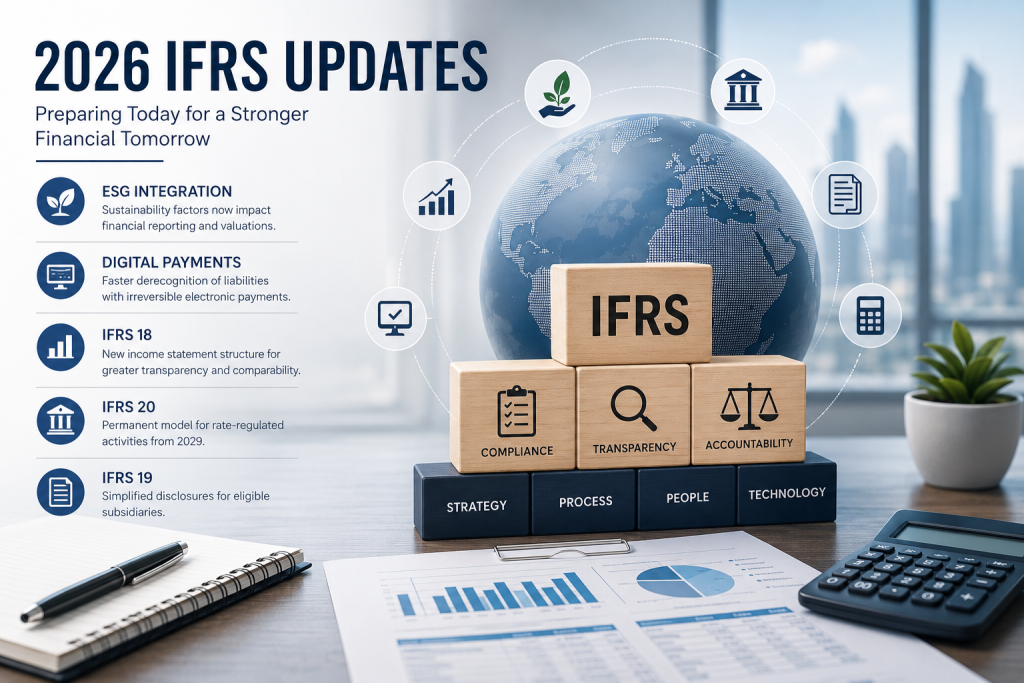
How UAE Businesses Should Prepare for the New IFRS Standards
Organizations should not wait until implementation dates arrive.
Instead, finance teams should begin preparing by:
- Reviewing existing accounting policies
- Assessing ERP and financial reporting systems
- Updating internal controls
- Training finance teams
- Evaluating ESG-linked financial instruments
- Preparing comparative financial information
- Reviewing disclosure requirements under IFRS 18 and IFRS 19
Early planning significantly reduces implementation risks and improves audit readiness.
How Imperium Accounting & Tax Consultants LLC Can Help
Keeping up with changing accounting standards requires more than technical knowledge—it requires practical implementation.
At Imperium Accounting & Tax Consultants LLC, we support businesses throughout the UAE with:
- IFRS implementation
- Financial reporting advisory
- Accounting outsourcing
- Corporate tax compliance
- Audit preparation
- Financial statement reviews
- Business advisory services
Whether you’re preparing for IFRS 18, IFRS 19, ESG reporting requirements, or future accounting standards, our experts can help ensure your organization remains compliant and financially prepared.
👉 Explore our services:
https://imperiumatc.ae/services/
Contact our team today to discuss how we can support your business through the evolving IFRS landscape.
Frequently Asked Questions (FAQs)
When does IFRS 18 become effective?
IFRS 18 becomes effective for annual reporting periods beginning on or after 1 January 2027, but comparative information requires businesses to prepare from 2026.
What is the biggest change introduced by IFRS 18?
The most significant change is the standardized presentation of the Statement of Profit or Loss, including mandatory operating, investing, and financing categories.
What is IFRS 19?
IFRS 19 provides simplified disclosure requirements for eligible subsidiaries without public accountability, reducing reporting complexity.
Why are ESG-linked financial instruments important under IFRS?
Recent IFRS amendments require ESG-linked contractual cash flows to be considered when determining financial asset classification under IFRS 9.
External Links (Authority Links)
To strengthen SEO and credibility, include references to authoritative sources:
- International Accounting Standards Board (IASB): https://www.ifrs.org/
- IFRS Foundation: https://www.ifrs.org/issued-standards/
- IFRS 18 Overview: https://www.ifrs.org/projects/completed-projects/2024/general-presentation-and-disclosures/