

Table of Contents
Introduction
The introduction of IFRS 18 Presentation and Disclosure in Financial Statements marks one of the most significant developments in financial reporting in recent years. Issued by the International Accounting Standards Board (IASB), IFRS 18 aims to improve the transparency, consistency, and comparability of financial statements across industries and jurisdictions.
As investors, regulators, and stakeholders increasingly demand clearer financial information, the new standard introduces structured requirements for presenting income and expenses, defining operating profit, and disclosing Management Performance Measures (MPMs). Although IFRS 18 does not change how profit is calculated, it significantly affects how financial performance is presented and communicated.
Effective for reporting periods beginning on or after 1 January 2027, organizations should begin preparing now to ensure a smooth transition and maintain compliance with international accounting standards. Businesses can review the complete IFRS 18 standard and implementation guidance published by the International Accounting Standards Board (IASB) through the official IFRS Foundation website. (Reference: https://www.ifrs.org/projects/completed-projects/2024/ifrs-18/)
Why IFRS 18 Presentation and Disclosure in Financial Statements Matters for Businesses
Financial statements are a critical tool for decision-making. Investors, lenders, regulators, and business owners rely on accurate and transparent financial information to assess performance and make informed decisions.
The objective of IFRS 18 Presentation and Disclosure in Financial Statements is to provide users with a clearer understanding of a company’s financial performance through improved presentation, enhanced disclosures, and standardized reporting requirements. By creating a more structured framework, IFRS 18 helps reduce inconsistencies and improves comparability between organizations operating in different industries and markets.
1. What Is the Primary Objective of IFRS 18?
The primary objective of IFRS 18 is to provide investors, regulators, and stakeholders with more transparent, consistent, and comparable financial information. The standard enhances the structure of financial statements by introducing clearer presentation requirements and more detailed disclosure obligations.
By improving the way financial performance is reported, IFRS 18 helps users of financial statements make better-informed business and investment decisions.
2. Will IFRS 18 Change a Company’s Net Profit?
One of the most common misconceptions is that IFRS 18 changes how profit is calculated. In reality, the standard does not affect a company’s reported net profit, earnings, or overall financial results.
Instead, IFRS 18 changes:
- How income and expenses are presented on the face of the income statement.
- How certain performance measures are disclosed.
- The level of detail required in financial statement notes.
The focus is on presentation and transparency rather than changing accounting measurements.
3. New Classification Categories for Income and Expenses
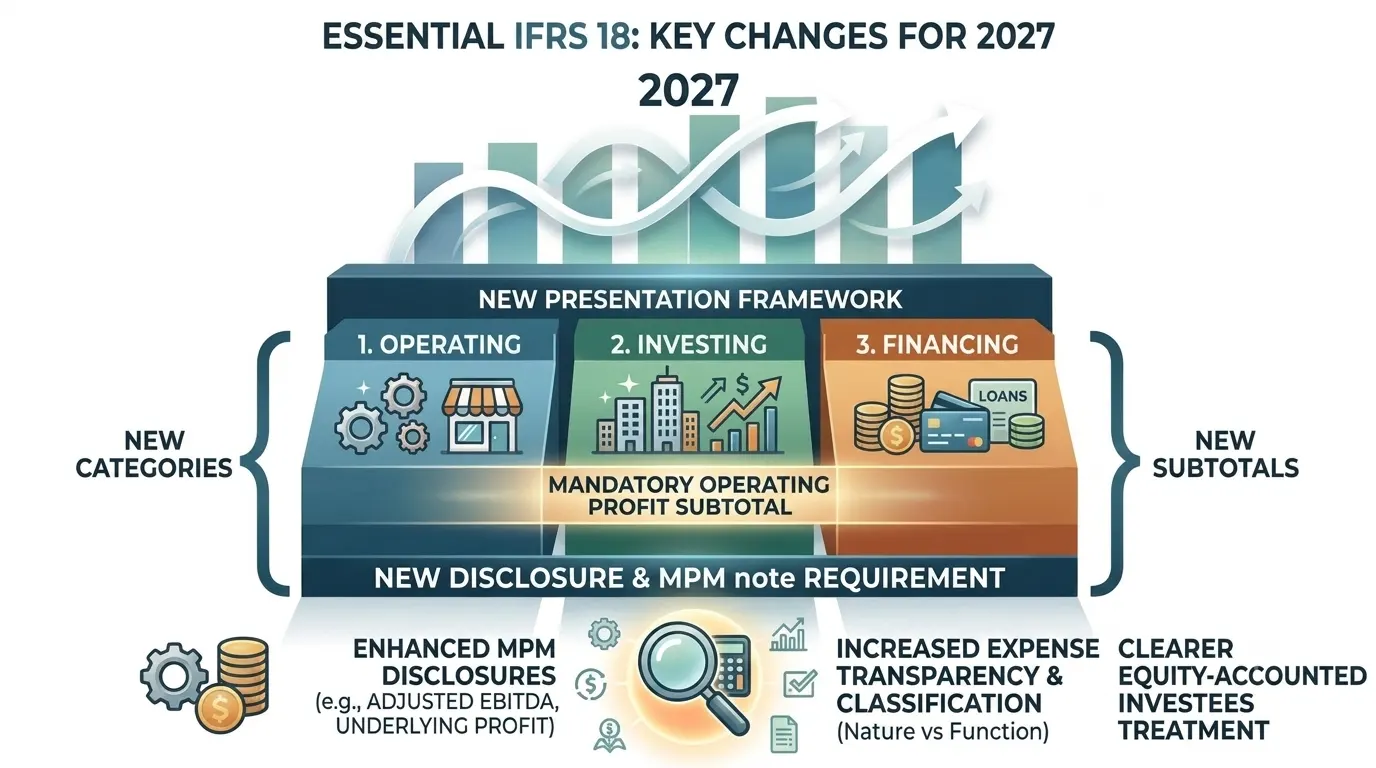
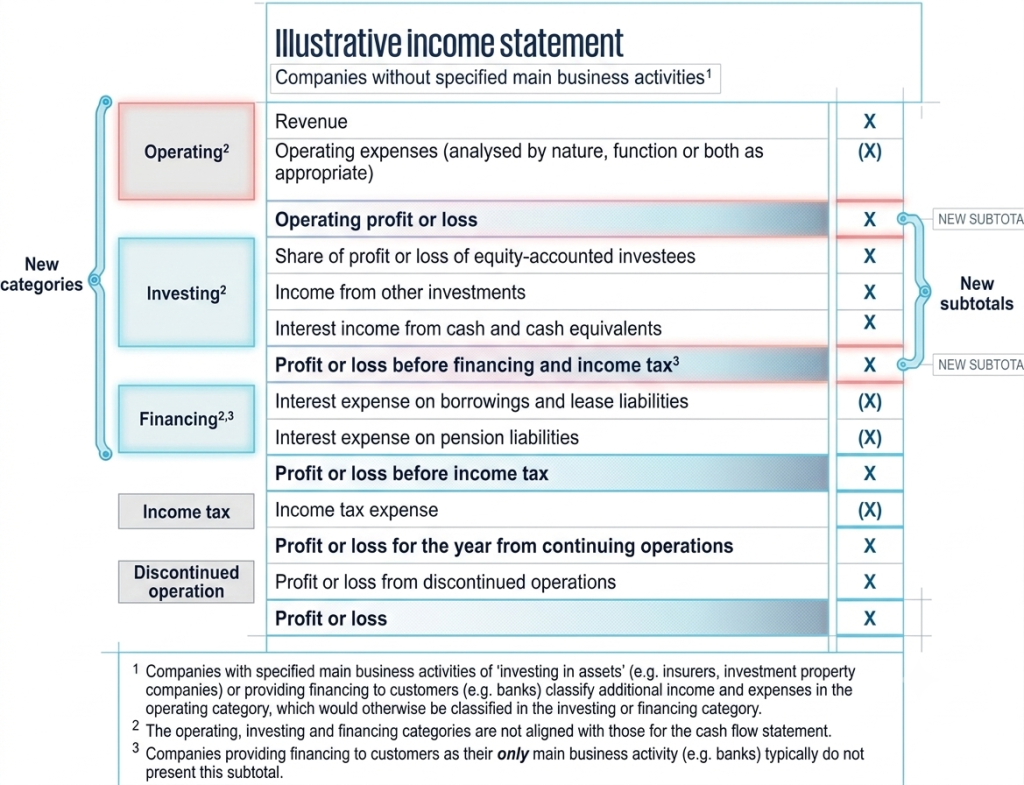
A major feature of IFRS 18 is the requirement to classify income and expenses into specific categories within the statement of profit or loss.
These categories include:
Operating Category
This category contains income and expenses arising from the company’s main business activities.
Investing Category
This category includes returns from investments that are generated independently of the company’s primary operations.
Financing Category
This category includes income and expenses related to financing activities such as borrowings and other funding arrangements.
This structured approach aims to improve consistency and comparability across different industries and organizations.
4. A New Definition of Operating Profit
IFRS 18 introduces a clearly defined operating profit subtotal, providing greater consistency in how companies report operational performance.
This standardized measure allows investors and stakeholders to better compare the operating performance of different organizations without relying on management-defined calculations.
The introduction of a mandatory operating profit subtotal is expected to become one of the most significant reporting changes under IFRS 18.
5. Changes to the Treatment of Equity-Accounted Investees
Under previous reporting practices, there was often inconsistency in how results from equity-accounted investees were presented.
IFRS 18 now requires the results of equity-accounted investees to be presented within the investing category rather than being included in operating profit.
As a result:
- Operating profit becomes a cleaner measure of core business performance.
- Investment-related returns are presented separately.
- Comparability between companies improves.
6. Enhanced Requirements for Presenting Operating Expenses
Companies have flexibility in how they present operating expenses. Expenses may be presented:
- By nature (e.g., salaries, depreciation, raw materials)
- By function (e.g., cost of sales, administrative expenses)
- Using a mixed presentation where appropriate
However, when a company chooses to present expenses by function, IFRS 18 requires additional disclosures regarding the nature of those expenses in the notes to the financial statements.
The objective is to provide users with greater insight into the underlying cost structure of the business.
7. Introduction of Management Performance Measures (MPMs)
IFRS 18 formally introduces Management Performance Measures (MPMs), bringing greater transparency to performance metrics frequently used by management.
MPMs are subtotals of income and expenses that management uses in public communications to explain its view of financial performance.
Examples may include:
- Adjusted Operating Profit
- Adjusted EBITDA
- Underlying Earnings
- Core Business Profit
Previously, these measures were often presented outside audited financial statements. IFRS 18 now requires additional accountability and disclosure regarding their use.
8. New Disclosure Requirements for MPMs
Organizations that present MPMs must provide a dedicated note within their financial statements explaining:
- Why the measure is useful.
- How the measure is calculated.
- The adjustments made.
- A reconciliation between the MPM and the closest IFRS-defined measure.
These requirements help users understand management’s perspective while ensuring transparency and preventing misleading presentations.
9. Greater Transparency Around “Other” Categories
Many organizations use broad labels such as “Other Income” or “Other Expenses” without providing sufficient detail.
IFRS 18 discourages excessive use of the term “other” because it can obscure important information.
Where such classifications remain necessary, companies must provide additional explanations and disclosures to ensure stakeholders clearly understand the nature of those items.
This change supports one of IFRS 18’s key goals: reducing ambiguity in financial reporting.
10. When Does IFRS 18 Become Effective?
IFRS 18 is effective for annual reporting periods beginning on or after 1 January 2027.
Key implementation facts include:
- Retrospective application is required.
- Comparative information must be restated.
- Early adoption is permitted.
- Organizations should begin assessing impacts well before the effective date.
Given the extent of presentation and disclosure changes, early planning is strongly recommended.
How Should Businesses Prepare for IFRS 18?
Although IFRS 18 does not alter accounting measurements, it may require significant operational and reporting changes.
Organizations should:
- Reviewing financial reporting systems.
- Evaluating chart of accounts structures.
- Updating internal controls and reporting procedures.
- Assessing Management Performance Measures currently used.
- Training finance and accounting teams.
- Communicating anticipated impacts to investors and stakeholders.
A proactive approach will help organizations manage the transition efficiently and maintain compliance.
Final Thoughts
The introduction of IFRS 18 Presentation and Disclosure in Financial Statements represents a major step forward in improving the quality and consistency of financial reporting worldwide. Through new income statement categories, a standardized operating profit subtotal, enhanced Management Performance Measure disclosures, and greater transparency requirements, the standard aims to provide stakeholders with clearer and more meaningful financial information.
While these changes do not affect a company’s underlying profitability, they significantly influence how financial performance is communicated. Businesses should begin evaluating the implications now to ensure they are fully prepared before the 2027 implementation deadline.
For official guidance on IFRS 18, businesses can refer to the IFRS Foundation and IASB publications. Organizations seeking professional support with IFRS compliance, financial reporting, accounting, taxation, and advisory services can also consult Imperium Accounting & Tax Consultants LLC to ensure a smooth transition to the new standard.
Related Services
At Imperium Accounting & Tax Consultants LLC, we assist businesses with:
- Financial Reporting and Compliance
- Accounting and Bookkeeping Services
- Audit Support and Advisory
- Corporate Tax Advisory
- IFRS Implementation and Consultation
- Business Financial Planning
Our team helps organizations stay compliant with evolving accounting standards while maintaining accurate, transparent, and reliable financial reporting.